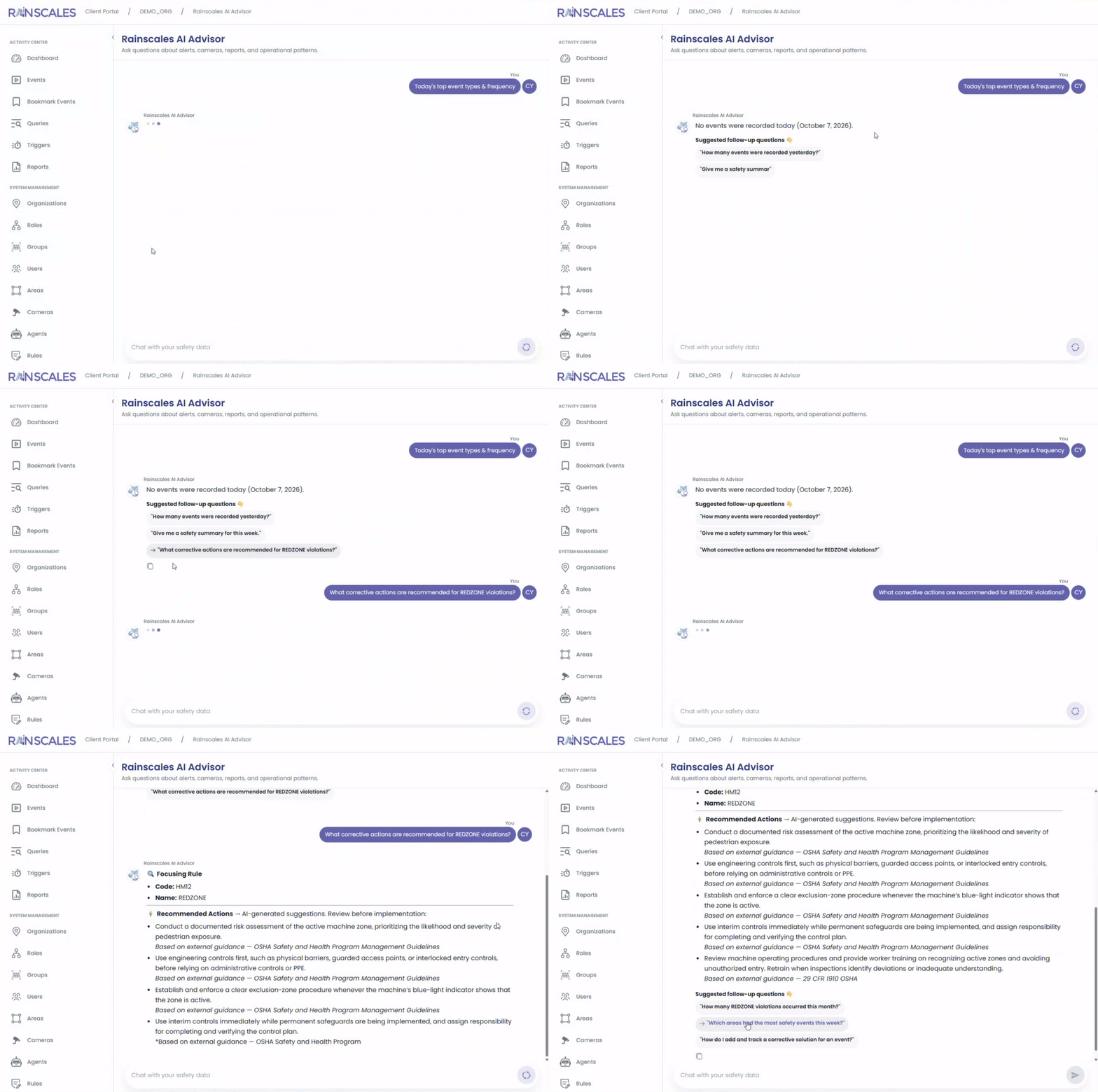
From First Camera to Full Production.
We're With You at Every Step.

Rainscales is not just software you're forced to deploy yourself. We coordinate with your camera vendors, configure and install edge hardware on site, manage the AI inference layer, and monitor performance from day one through full-scale production.

Scout the Owl with telescope
THE PROBLEM WITH AI DETECTION

Most vendors hand you software and walk away.

Getting cameras connected, edge hardware configured, vendor integrations working, and alerts actually reaching the right people on the right device, that's where most AI detection projects fail. The software works. The deployment doesn't.

HOW RAINSCALES IS DIFFERENT

We manage the whole thing, in your environment.

Rainscales coordinates with your existing camera vendors, installs and configures edge devices on site, integrates with third-party hardware and dashboards, and monitors performance continuously. You get a working system, not a software license to figure out yourself.

WHY IT MATTERS

What a managed service partner actually delivers.

Most AI detection vendors hand you software. We hand you a working system, fully coordinated, configured, and monitored from day one.

1

We coordinate with your vendors

Rainscales works directly with your camera suppliers, IT teams, and hardware partners before any AI layer is introduced.

2

We configure and deploy on site

Our team installs edge devices, defines detection zones, and connects alerts to the right people.

3

We monitor and improve continuously

Rainscales tracks system health, alert quality, and detection performance from production day one.

THE MANAGED SERVICE LIFECYCLE

Six stages. One team. Continuous delivery.

Scout
1
Assess & Scope
Review footage, define success criteria, confirm infrastructure requirements, and agree on detection rules before any live connection.
Scout
2
Vendor Coordination
Rainscales works directly with your camera suppliers, IT teams, and hardware partners to establish access, connectivity, and data flows.
Scout
3
Configure & Deploy
Edge hardware installed on site. Detection zones defined. AI inference calibrated to your environment, workflows, and detection rules.
Scout
4
Integrate & Train
Alerts routed to the right people. Supervisors trained. Escalation protocols set. Every stakeholder knows what they'll see and what to do.
Scout
5
Monitor & Validate
Rainscales tracks system health, alert quality, and detection performance continuously, tuning the model as your environment changes.
Scout
6
Expand & Optimize
New sites onboarded using the proven playbook. New use cases scoped from operational feedback. ROI measured against original success criteria.
Scout
Rainscales manages every stage, so your team stays focused on operations, not implementation
THE COMPLETE PROCESS

From first look to full production.

Rainscales structures every engagement around a shared delivery plan that keeps your team aligned, tracks progress against defined goals, and provides visibility into every step, from first footage review through full-scale rollout.

Select a stage to explore what happens at each step.

POC LITE  •  5–10 BUSINESS DAYS
Historical Footage Review

Rainscales reviews your existing CCTV footage against agreed detection rules and success criteria, no live connection required. You see real findings from your own environment before any infrastructure commitment.

  • Kickoff: footage handoff, success criteria confirmed, results meeting scheduled
  • Detection analysis run, early findings mapped to agreed goals, midpoint alignment session held
  • Final findings reviewed with stakeholders, ROI narrative drafted, go/no-go decision made
Scout
What This Stage Delivers

What you walk away with

Real findings from your own environment, before any infrastructure commitment. A clear go/no-go decision backed by evidence, not assumptions.

CONNECTED POC  •  30 DAYS
Live Camera Evaluation

Rainscales connects to a subset of your cameras, activates selected detection rules, and runs a live 30-day evaluation with weekly alignment reviews and KPI tracking against your agreed baseline.

  • Implementation week: Cameras connected, rules activated, users trained on alerts and reporting
  • Alert quality reviewed, false positives addressed, corrective actions documented
  • KPI progress vs. baseline reviewed, expansion use cases identified, rollout scope recommended
Scout
What This Stage Delivers

What live connection proves

Detection validated against your actual cameras, workflows, and alert routing. KPIs tracked against your agreed baseline from day one.

READINESS  •  WEEKS 1–3
Scoping Your Full Rollout

POC findings are the foundation. Readiness maps what was proven in your pilot environment to the rest of your sites, identifying which locations, use cases, and teams are next, and what it takes to get there.

  • POC results reviewed and translated into full-site rollout scope
  • New locations and use cases prioritized based on pilot performance
  • Infrastructure requirements confirmed for each additional site
  • Success criteria updated with POC actuals as the new baseline
  • Procurement and deployment timeline agreed with stakeholders
Scout
What This Stage Delivers

What readiness delivers

A site-by-site expansion plan grounded in POC actuals. Every vendor, system, and stakeholder confirmed before hardware ships.

INSTALLATION  •  WEEKS 4–9
Scaling Across Sites

The hardware configuration and detection settings proven in the Connected POC are now replicated and expanded across all sites in scope. What worked in the pilot becomes the standard for every new location.

  • POC camera configuration and zone settings replicated site-wide
  • Detection rules tuned per site using pilot performance as a baseline
  • Alert routing extended to new sites, teams, and stakeholder groups
  • Edge hardware deployed using the standardized POC playbook
  • System health monitoring expanded across the full environment
Scout
What This Stage Delivers

What installation locks in

Your POC configuration, proven, documented, and replicated across every site in scope. No guesswork. No starting over.

INTEGRATION  •  WEEKS 10–13
Rolling Out to the Full Organization

The alert workflows, escalation protocols, and supervisor training established during the POC are extended to every site and team. What worked for the pilot group becomes the standard across the organization.

  • POC alert and escalation protocols adopted org-wide
  • Supervisor training scaled from pilot team to all site managers
  • Frontline onboarding uses the POC-proven approach and materials
  • Incident response and SOP documentation updated across all sites
  • Adoption tracked per site against POC engagement benchmarks
Scout
What This Stage Delivers

What full integration means

Every team trained. Every escalation protocol documented and tested. Org-wide adoption tracked against your pilot benchmarks.

LAUNCH  •  WEEKS 14–24
Full Production, Measured Against What You Set Out to Prove

All sites go live. Performance is tracked against the success criteria defined at kickoff and the actuals established during the POC, so every stakeholder can see exactly how far you've come and where you're headed.

  • Full production monitoring active across all sites and use cases
  • Weekly reviews track progress against POC-defined success criteria
  • Alert accuracy and volume benchmarked against pilot performance
  • Adoption tracked across all teams and locations
  • 30/60/90-day milestones reported to executive sponsors
Scout
What This Stage Delivers

What launch looks like

Full production across all sites, measured against the exact success criteria set at kickoff. Executive-ready reporting from day one.

OPTIMIZE  •  MONTH 6+
Expanding Use Cases, Refining Results

With production data across multiple sites, detection models are refined, new use cases are scoped from operational feedback, and the program expands, building on everything learned from the POC through full deployment.

  • Detection models tuned using cross-site production data
  • New use cases identified from operational feedback and results
  • Additional sites onboarded using the proven deployment playbook
  • ROI measured against success criteria set at the original kickoff
  • Long-term roadmap developed with your Rainscales delivery lead
Scout
What This Stage Delivers

What continuous optimization delivers

Models refined with cross-site data. New use cases scoped from real operational feedback. ROI measured against original goals.

DELIVERY & SUCCESS TRACKER

How Rainscales keeps every step visible and accountable.

At the start of every engagement, Rainscales deploys a shared implementation tracker. It aligns your team around agreed success criteria, tracks dependencies and ownership, documents findings in real time, and gives every stakeholder, from executive sponsor to frontline supervisor, a clear view of where things stand.

Success Criteria

Define what success looks like and how it will be measured before the POC begins. Baseline metrics captured at kickoff, tracked against actuals throughout.

Evidence Collection

POC findings are documented and mapped to agreed goals in real time. Results are ready for executive review at the end of each phase, not reconstructed afterward.

Stakeholder Alignment

The tracker surfaces what each stakeholder group needs at each stage, from IT security review to executive sponsor briefings and frontline user adoption.

Rollout Readiness

At POC completion, the tracker auto-generates a one-page executive summary and a scoped proposal ready to take to leadership, with confirmed ROI actuals attached.

16–24
Weeks from POC completion to full production
90
Days to first production performance benchmark
7
Structured stages with defined exit criteria
1
Dedicated Rainscales delivery lead throughout
CHANGE MANAGEMENT

How Rainscales supports your rollout from day one.

Deployment success depends as much on people as on technology. Rainscales embeds a structured communication and change-management plan into every engagement, with touchpoints tailored to each stakeholder group throughout the rollout.

Stakeholder
Pre-Launch
Go-Live Week
Month 1
Ongoing
Executive Leadership
VP Ops, Safety Director, CIO
Scope sign-off Pilot outcome debrief, success criteria confirmation, rollout budget approval
Launch brief Go-live announcement, expected alert volume, escalation chain confirmed
ROI summary 30-day performance vs. pilot baseline, adoption rate, incident trend
Quarterly review 90-day benchmark report, expansion recommendation, model improvement log
Operations Managers
Shift leads, floor supervisors
System walkthrough Dashboard orientation, alert categories explained, feedback channel opened
Hands-on training Live alert review, response protocol rehearsal, escalation drill
Q&A session Alert fatigue review, zone adjustment requests, workflow refinement
Weekly ops meeting Alert summary integrated into existing standup, ongoing tuning requests
Frontline Staff
Operators, technicians, associates
Awareness brief What the system does, what it does not do, privacy and data use explained
In-shift intro Supervisor-led explanation at shift start, visible signage placed in monitored zones
Feedback loop Anonymous feedback channel, common questions answered in team briefings
Normalized use Detection embedded in existing safety huddles, no separate AI meetings required
IT and Infrastructure
Network, security, systems teams
Technical brief Architecture overview, network requirements, data flow and retention policy
Config handoff System credentials, monitoring access, escalation contact for tech issues
Health review Uptime report, bandwidth utilization, edge device status across all nodes
Update cadence Scheduled model updates, firmware patches, security review schedule confirmed
Scout
What makes this work in practice

Rainscales assigns a dedicated deployment lead to every engagement who owns this plan end-to-end, coordinates between your stakeholder groups, and adapts the communication cadence to your existing meeting structure. You don't manage the rollout communications. We do.

Managed Service in Action

How do you deploy intelligent detection when your infrastructure never stays in one place?

This is what end-to-end managed service looks like in practice. A large industrial services company operating across a fleet of mobile sites, no fixed infrastructure, no permanent camera setup, environments shifting constantly. Rainscales handled every piece of it: setup, configuration, vendor coordination, and ongoing monitoring, without the client's team managing a single thing. If we can do it in that environment, we can do it in yours.

Setup & Configuration

Edge hardware configured at each site from scratch, detection zones defined, and camera feeds connected, regardless of vendor or architecture.

Ongoing Implementation

As sites shifted and environments changed, Rainscales reconfigured, redeployed, and kept detection accurate without requiring the client to manage anything.

Continuous Monitoring

System health, alert quality, and detection performance tracked from day one. The client gets results, not a platform to manage.

WHERE WE OPERATE

Applied AI in environments that don't forgive shortcuts.

Scout

Warehouses and Distribution Centers

We configure detection across high-traffic zones, dock doors, and fulfillment aisles, integrating with your existing camera infrastructure and routing alerts to floor supervisors in real time.

Healthcare Facilities

We coordinate with clinical IT and security teams to extend detection to patient care corridors and high-risk zones, with alert routing that respects clinical workflows and escalation protocols.

Manufacturing Floors

We map detection zones to your floor layout, calibrate rules for machine proximity and PPE compliance, and update configurations as production lines or shift patterns change.

Oil and Gas Operations

Rainscales has deployed to active, moving oil fields, coordinating with multiple camera vendors, running AI inference locally on edge hardware, and maintaining system reliability in extreme heat and shifting layouts with no fixed infrastructure.

Construction Sites

We reconfigure detection zones as site layouts evolve, ensuring active work areas, equipment staging, and perimeter boundaries stay covered throughout the project without requiring IT involvement on your end.

Multi-Site Operations

Each expansion site replicates the configuration, vendor integrations, and monitoring protocols proven at the first deployment, so scale doesn't mean starting from scratch.

EXPLORE OTHER RESOURCES

See how this roadmap applies to your environment.

Start with the site or department where the need is clearest, prove value against defined criteria, and expand across your portfolio on the same connected foundation.

Get Started with Deployment → See If Your Site Is Ready →